• Skip to primary navigation
  • Skip to main content
  • Skip to primary sidebar
  • Skip to secondary sidebar

John Du Cane

  • Books
  • Reviews
  • Blog
  • About
  • Contact

John Du Cane

Confessions of an Emotional Eater

January 14, 2018 By John Du Cane

“You may continue to eat emotionally until you take consistent action to create a satisfactory and meaningful life.”—Laura Houssain

When we suddenly feel vulnerable, what do we turn to for relief? When emotional distress triggers a craving for release, what do we reach for? When the pain won’t stop, what do we grab? When the dull ache spreads out from our heart, how do we numb it? When sorrow spills its slick, how do we soothe it?

In our using days, we often turned to our drug of choice to handle or run from those emotional challenges. In recovery, we have learned many skills to cope successfully with the emotional flares ups—or the chronic unease of long-held, long-stuffed feelings. However, food can be a cunning foe—because it is so much our friend and benefactor in the normal course of things. No food, no life.

It’s one thing to crave something salty or sweet when the mood is upon us—and to wolf down a few extra crackers or chocolate donuts. Little harm in the occasional food fling—it can do the soul a world of good to indulge without guilt once in a while. Right?

However, if we find ourselves compulsively gorging on dollop after dollop of sugar-saturated health bombs; if we find ourselves guiltily munching on fistful after fistful of oily fries; if we feel bad and immediately think of food—then we might just be “emotional eaters”.

Anything that puts us out of whack, creates a vulnerability for those of us in recovery. It just makes staying straight and serene that much tougher. Emotional eating, by its nature, sets up a dependency pattern that masks our feelings and can put our recovery at risk.

From the menu of fitness options available to help dis-empower the beasties of emotional eating, let’s order up a heavy-duty entrée: the push-up. The push-up requires significant energy expenditure and determination to accomplish. So, we are going to really push that push-up here. Time to grim and bear it—so a little while later we can smile and be glad we are not stuffing down our tenth donut…

Here we go:

Kneel on the ground. Place your hands on the floor at shoulder’s width. Raise your knees up and extend your legs until your whole body is in a plank-like posture. Keep your butt in line with your spine. Tighten your abs. Take about two seconds to gently lower yourself down until your chest almost touches the floor. Push up into your original position. Inhale and hold your breath on the way down. Exhale when you push up. If the full push up is initially too challenging for you, perform the movement while resting on your knees. Do as many complete repetitions as you can manage with good form. Leave a little in the tank at the end of your set. Get up and walk around for a minute. Do another two sets. Or three. Or four. Burn out those beasties! Scatter their ashes to the winds!
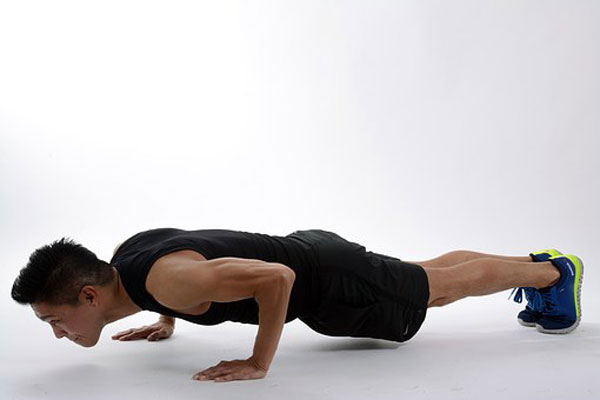
push-ups January 14

Yes, depending on your current conditioning level, this may leave you sore. Sore—but satisfied. Satisfied in your body and satisfied in your mind. You just successfully torched that emotional upset—which, you have to admit, feels pretty darn good…

I am grateful to discover how vigorous exercise can help safeguard me against unwise eating habits.

Filed Under: Spark Your Day Tagged With: emotional eating, emotions, exercise, push-ups, vigorous exercise

A Tap. A Rap. A Hit.

January 13, 2018 By John Du Cane

“Inaction is followed by stagnation. Stagnation is followed by pestilence and pestilence is followed by death.”—Frederick Douglass

Stagnation. It conjures images of ooze and slow-bursting bubbles of gas, of green slime, of sticky, fetid muck, of something softly rotten. Stagnation occurs when the life force has been blocked from its natural flow. In humans, that life force would be oxygen, blood, nutrients, chi… Our channels have become strangled through inactivity, poor diet, stress, unrelieved tension, emotional disturbance—and perhaps the extended abuse of drugs…

To allow stagnation to continue to fester within us, is to march ourselves that much faster into our decline. The symptoms may be reduced energy, foggy thinking, chronic pain, irritability, lack of mobility, poor digestion or uneasy dreams. We are allowing ourselves to be dragged down by the weight of the sediment silting up those vital channels.

But fortunately, it is never too late to jump back into action—and start turning our energy around. Simply moving around for a few minutes a day can begin to work wonders on clearing that sludge from our interior systems—bringing back a shine to the eyes and a bounce to the gait…

A magnificent way to enliven our energy systems—and to start exorcising those demons of stagnation—is to tap, rap or hit key acupoints along the body’s meridians. Depending on the condition we want to work with, we can enliven ourselves with some delicacy (tapping), some vigor (rapping) or some outright tough love (hitting).

Today, it’s time to administer some tough love:

Sit on the edge of a firm seat, with your knees bent. Or even better, stand with feet shoulder width apart and knees slightly bent. Place the heel of the right palm on the left kneecap. Rotate the hand about forty five degrees, counter clockwise. Note where the tip of your middle finger is situated. It will be resting on a famous spot known as the “Walk Three Miles Point”—so-called, because enlivening this acupoint will give us greater stamina and strengthen our legs. Now, find the same acupoint on the right leg.

A Tap. A Rap. A Hit.

Good, you are all set. Turn your hands into fists. You are going to strike those Three Mile points with the inside part of each fist. Because of the size of the fist area, you don’t have to be too concerned about the exact strike zone for the acupoint (AKA Stomach 36). Hit the point 24 to 36 times. How hard you hit is very much up to you. Naturally, go easy to start with, then ramp up the force and volume as you feel what you can manage.

I am excited to reduce stagnation in my body and enjoy a safer, healthier life.

Filed Under: Spark Your Day Tagged With: acupoints, energy, meridians, stagnation, stamina, tapping, vigor

Stepping Up to Change

January 12, 2018 By John Du Cane

“We are only stable because we constantly change.”—Charles Richet

Change is a core condition of life that in and of itself has no value attached. Change becomes good, bad or indifferent, only when we attach our own particular perspective to it.

As addicts, we tended to want to lock down change as our personal property. We would try to muscle change to obey our will—bend it to our own desires. We would attempt to control and manage change into our own image. Got a difficult partner? Change them or lose them! Not high enough, satisfied enough? Grab more and more and more… Work getting you down? Quit! Not enough money? Steal some! The list goes on and on…

Often, we would bang our heads against an unchangeable force until we’d be left with cracked and bleeding skulls… Or we’d slink away, tails in the mud, from the changes we could—and needed—to make.

In recovery, we famously learned to accept change when it was clear there was no other sensible option. We learned to be courageous and make change happen—when the change was there for us to make. The art and wisdom though, is to discern what can indeed be changed and what cannot. In recovery, we cultivate this discernment one careful, considered step at a time. We step up to make a change. We step down from a misguided attempt to force ourselves on change. Step up, step down. Step up, step down.

The Next Step

Here’s a secret: if you meditate on something while you are in a physical activity, it helps empower that meditation—when the movement is practiced with good attention. So, when you do the very simple drill below, meditate on the nature of change—and your relationship to change—while you perform the movements.

Find a stable surface that’s anywhere from one foot to around knee height. Select a height that is somewhat challenging, but which you can manage with good form. It could be a bench or a staircase, for instance. Stand close, then step up with your left leg onto the bench. Step up now with the right leg, so you are standing upright on the bench. Step back down with the right leg, keeping the left leg on the bench. Repeat the stepping up and down with the right leg for from ten to twenty repetitions. Switch to the other side.

Voila, you just made some positive changes to your strength and mobility!

It feels great to take an action today that has a positive effect on my body.

Filed Under: Spark Your Day Tagged With: change, mobility, step up, stepping, steps, strength

Open and Close, Open and Close, Open and Close…

January 11, 2018 By John Du Cane

“When the highest hear the Tao, they practice it with diligence. When the average hear the Tao, they question it. When the lowest hear the Tao, they scoff at it.”—Lao Tzu

When we were using, we shrouded our game in endless veils of secrecy. In fact, one definition of an addict could be a person who keeps secrets even when there is no need to be secret. Secrecy was our M.O. And there was so much we felt we needed to keep secret. Shame and fear kept us closed—until being closed became our second nature.

In recovery, we were encouraged to swing to the other end of the pendulum—and be open about everything. As the adage in the recovery community would have it: “we’re only as sick as our secrets.”

However, the delicate flower of our burgeoning new spirituality can be damaged when exposed to the harsh winds of judgement and prejudice. We work a spiritual program, but it’s a spiritual program that needs protection. There’s a reason for anonymity and confidentiality. There’s a reason to let trust grow at a natural, careful pace. There is a reason to be on guard against the predatory and abusive forces perhaps eager to destroy our newfound life.

What is sacred to us can be profane to others. What we esteem, others can ridicule. So, let’s be open in moderation—as in all things—and be ready to close like a flower at dusk, when the light begins to darken. Let’s choose to practice our recovery with quiet diligence. There’s plenty of time to shine. And plenty of time to rest unseen in the shadows, as we cultivate our serenity. Let this sensitivity be our strength.

Our natural state is a constant shifting from open to closed and back. We open our breath, we close. We expand our bodies, we contract. We reach out, we pull back. We gaze out, we look within.

Open Close

So, let’s express these sentiments through a few minutes of spontaneous movement. Not so much vibrating and shaking, but rather flowing in a supple easy manner. Our constricted post-apocalyptic selves may feel self-conscious, initially, to move without any particular pattern or discernible order. Just let the body’s inner wisdom take over, with no mentally preconceived steps or forms. Healing will happen from this—if we let it…

I feel the freedom and joy of my body moving to its own inner music.

Filed Under: Spark Your Day Tagged With: community, openness, recovery, secrets, spontaneity, spontaneous movement

The Great Connector

January 10, 2018 By John Du Cane

“Only connect! That was the whole of her sermon. Only connect the prose and the passion, and both will be exalted, and human love will be seen at its height. Live in fragments no longer. Only connect.”—E. M. Forster

Did we have good connections in our using days? Well, the answer is probably “Yes, no, maybe.” Our connections might best be described as The Good, The Bad and the Ugly. We connected all too well to the bottle, the spike, the rail, the spliff, the pipe, the bong, the… whatever our preference. But we connected not so well, perhaps, to our relatives, friends, colleagues, loved ones and the like.

Our relationship with the world was fractured—because the relationship with our own self was fractured. We were creatures broken to fragments on the wheel of our addiction…

Connection implies and requires other-centeredness. Connection implies balance, flexibility and open channels. Before recovery, we tended toward supreme self-centeredness. We were preoccupied by our own pain and our never-ending quest to medicate ourselves out of discomfort. We were just way out of whack—to use a technical phrase.

Now, our lack of connection to others did not show up just on the emotional, social and mental planes. Our addiction’s excesses afflicted our body too. The neural pathways got blocked. Blood flow compromised. Muscles got taut and tight and bunched and knotted. Shoulders got hunched. Foot, knee, hip and back pain asserted their angry voices. Fascia twisted and wound up. Our joints could sound like grinding gears…

And from lack of use or from imbalance in our structure, many of our muscles would simply cease to fire on demand. They’d given up the ghost on helping us through the day in an efficient manner. Sensory-motor amnesia had dulled our once finely tuned machines to sputtering inefficiency.

In recovery, if we choose to disregard our physical dysfunctions and not work to fix them, we may be putting our serenity and sobriety at risk.

Today, we will practice a simple exercise to loosen up our almost certainly tight hip flexors. Also known technically as the psoas, the hip flexors are THE great connectors between our upper and lower bodies. If our psoas is out of balance, constricted or tight, we will for sure be affected on every level of health, be it emotional, spiritual or brutely physical. We are following the Spark Your Day formula here. Protect your vulnerabilities, by addressing the physical—that this in turn helps heal your heart, mind and spirit.

Psoas Diagram

Ready to release and connect? Here we go:

Sit upright on the edge of a hard chair. Place the blade of your left hand in the crease between your right thigh and your torso—AKA the inguinal crease. Place your right palm gently on the top of your right knee. The right hand helps to maintain focus on the correct alignment—keep the touch light. Keep your foot, knee and hip in alignment as you raise your leg up, around nine inches. Repeat for 20 repetitions and then switch to the left leg. You’re done. However, your hips will be thankful if you make time twice more in your day to perform the same routine. Continue to do this every day forward and you will be thrilled at how much better you feel.

It feels great to gently reawaken the dormant connections in my body.

Filed Under: Spark Your Day Tagged With: connection, flexibility, hip flexors, hips, psoas

  • « Go to Previous Page
  • Page 1
  • Interim pages omitted …
  • Page 13
  • Page 14
  • Page 15
  • Page 16
  • Page 17
  • Go to Next Page »

Primary Sidebar

About The Author

John Du Cane CubistStylePortrait316x400
Illustration by Judit Tondora

John Du Cane is a publisher and writer. He is the founder of Dragon Door Publications and is best known for having launched the modern kettlebell movement in 2001 and for the publication of the international bestseller Convict Conditioning. Most recently he collaborated with Debbie Harry on the writing of her New York Times bestselling memoir Face it.

Contact: support@johnducane.com

John Du Cane CubistStylePortrait316x400
Illustration by Judit Tondora

Contact: support@johnducane.com

Privacy Policy

Secondary Sidebar

Books

The Illustrated Wild Boy by John Du Cane

“An absorbing memoir perfectly complemented by exquisite art.” — Kirkus Reviews

“It’s rare to find a multifaceted short story collection of vignettes whose tales are equally well rooted in artistic, personal, and social observation. The result is a creative and involving work of art, language, and social inspection that will delight readers looking for literary works strong in spiritual and social revelations.” — Midwest Review of Books

Face It Debbie Harry

I spent around eleven months helping Debbie Harry with the writing of her memoir. Check it out and let me know what you think!

Books  |  Reviews  |  Blog  |  About  |  Contact


Copyright © 2026 John Du Cane