• Skip to primary navigation
  • Skip to main content
  • Skip to primary sidebar
  • Skip to secondary sidebar

John Du Cane

  • Books
  • Reviews
  • Blog
  • About
  • Contact

John Du Cane

Cutting The Ties That Bind

February 15, 2018 By John Du Cane

“Letting go means to come to the realization that some people are a part of your history, but not a part of your destiny.”—Steve Maraboli

It can hurt to cut ties with someone that we were close too—even loved at one time. But now, the relationship has gone south for every reason under the sun. The fruit has rotted beyond saving. Yet we are still holding on, as if the rotten piece of fruit will somehow magically reconstitute itself as fresh and good to eat.

To cling at this point to the decayed relationship can only bring suffering for both partners—the suffering of lies, denial and a general evasion of the truth. So, let’s look at the small immediate hurt of taking an axe to the rope now, rather than extending our bondage into a dis-eased future.
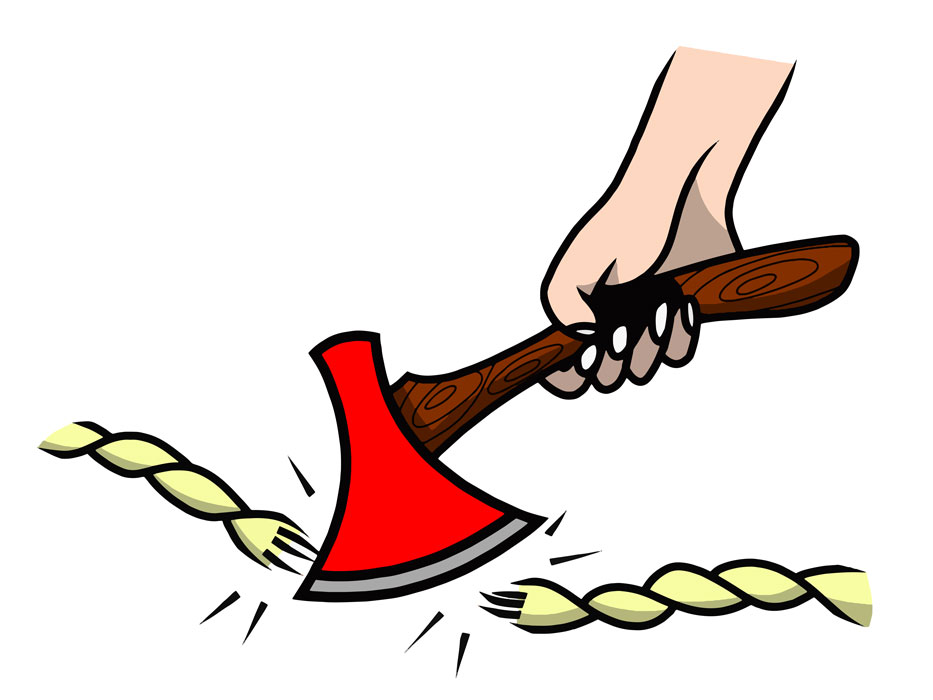
Cutting Ties

Ironically, we often extend decayed relationships because we are being delusionally “nice.” We worry that we are going to needlessly offend or hurt the other person. Better to just let things slide… Perhaps they will just get the hint—and drop off the vine. We came to realize, though, once we entered recovery, that the gentle let down can simply prolong the pain. And other folk are far more resilient than we often give them credit for. A more respectful approach can often be an amicable chopping of the ties that bind.

In our using days we formed all kinds of ill-fated and toxic relationships. These relationships would hang around us like a miasmic cloud. Getting clean has been a process of washing away the root causes of that unfortunate mist. We handle this at the speed that is safe for us to manage without plunging into counterproductive stress. The good news is that the more we act to clean, the more easily the cleansing unfolds.

Let’s take a moment now to contemplate a relationship that may have overstayed its welcome. Are we ready to invite the guest to leave—with grace and no hard feelings?

“Shaking out the spirits” is a good way to prime the release from a toxic relationship.

Here’s what to do:

Stand in a relaxed posture. Close your eyes. Feel your body for a minute, scanning yourself with your attention from top to toe. As the mood takes you, start to shake your hands, then your arms, then your shoulders, then your torso, then your hips then your legs. Let your head gyrate and bobble of its own accord. There’s no right away, just keep shaking and shaking and shaking some more…

Continue for a few minutes, ten minutes, or even longer—until you feel complete.

I feel a lightness of being as I release from the bonds that hold me down.

Filed Under: Spark Your Day Tagged With: letting go, relationships, release, shaking, ties that bind, toxic relationships

Love, Naturally

February 14, 2018 By John Du Cane

“All you need is love. But a little chocolate now and then doesn’t hurt.”—Charles M. Schultz

Today, we traditionally celebrate the romance of love. Lovers swap cards, send roses, have special dinners, savor some dark chocolate and reaffirm their affection for each other. That love can be like a faint mist that disappears with the first of the sun’s rays. That love can be as deep as the ocean. That love can be as dry as tinder or as moist as a fig. That love can come unadorned or dressed in regal splendor. It can be wildly immature or seasoned beyond measure. Love can be infused with a heartfelt spirit or it can be hanging by a miserly thread. In other words, love takes as many forms as there are hearts in the world to hold it. And these forms are in constant flux.

The contemplation of romantic love on Valentine’s Day, though, can be bittersweet for those of us in recovery. Valentine’s day is as likely to evoke pain and regret and a sense of loss as it is to inspire happiness and connection. Addiction so often is the great breaker of relationships, the love-destroyer, as it were. In our compulsive, self-centered pursuit of chemical hits, we had little time to spare for the niceties of love and care. To devote energy to another was to waste energy better used in the service of our addiction. Or, so we thought.

When we entered recovery we were encouraged to open ourselves to love, but with a significant caveat. We were asked not to confuse love with our sex drive. Yearning to replace the lost relationship with our chemicals, we could become overly desperate, clingy and wanting in a risky pursuit of sexual satisfaction. Most of us react poorly to being pressured into “love”, as much as we love to love and love to be loved. And when love is forced, we enter volatile territory.

In recovery, we learned to tamp down on the excitement some. We grew our love through kindness and compassion—and did our best to go easy when the laws of attraction exerted their power over us.

Love

So, today, let’s reflect a moment on who and how we love. And we can consider softening into gentle appreciation and gratitude for the love we have been granted to give and receive.

In that spirit of a gentle approach to love, let’s perform this remarkably soothing movement:

Sit or lie in a relaxed posture. Smile with your eyes. Bring your right palm to within about two inches of the center of your chest. Pause and feel your heart area a moment. Now slowly move your right palm across your chest to the left, to the shoulder. In a continuous, slow, smooth movement run your palm down the outside of your arm until it passes over you left fingertips. Pause a moment, the reverse the movement until you palm is back over your mid-chest. Repeat a total of eight or more times. Then switch, so your left palm strokes from your heart area to the tips of your right fingers and back to the heart. This will feel surprisingly relaxing and delicious.

I give myself love and this love emanates back out into the world.

Filed Under: Spark Your Day Tagged With: compassion, kindness, love, relaxation, self-love, soothing movement

Manipulation

February 13, 2018 By John Du Cane

“When it comes to controlling human beings, there is no better instrument than lies. Because you see, humans live by beliefs. And beliefs can be manipulated.”—Michael Ende

Most of us would agree that one of the most unpleasant feelings we can have is the feeling of being manipulated—taken for a chump, disrespected, deceived with charm and cunning. We feel soiled. We feel soiled because we are manipulated by what we most believe in—what we hold precious and dear to our hearts. The more powerfully we believe, the more powerfully we can be manipulated by a play on those beliefs. Yes, sure, we can be manipulated through our baser impulses—such as greed—but what hurts most is the betrayal of our trust, the crucifixion of our dreams…

In our using days, we took graduate courses in lying, cheating and manipulation. Getting what we wanted at others’ expense defined our MO. We figured if we just lied long enough and hard enough our lies would become the truth. We could assert with utter conviction that a banana was actually a sausage. Not only would we come to believe ourselves that a banana was not a banana, but a sausage—we would watch as others ate the banana and declared it to be the most wonderful-tasting sausage in the world. Hey, mission accomplished!

Manipulation

Fortunately, in recovery we revere honesty as a core and necessary virtue, to ensure we remain resilient in our program. The more we can get used to facing life without feeling the need to manipulate and deceive, the better chance we have to be serene and at peace. Lying, by its nature, weakens the links in the chain of our well-being. And the weaker any link, the weaker the overall program. Break a link completely and we enter dangerous territory…

Of course, old habits die hard—and “constant vigilance” is the catchphrase when it comes to manipulation. We self-correct when we see ourselves start to manipulate—and we call out others who would manipulate us. It’s an ongoing tango of respectful adjustment at its best. But left too long to fester, and we’ll find ourselves in a scrum, elbows out, kicking, pushing and shoving. And for those of us in recovery, the scrum is not a good place to hang out…

Today, let’s reflect on our progress with manipulation. How are we doing? Could there be a beneficial course correction we could make today—that would ease our lot and the lot of others?

Manipulation derives from “handwork”, so for today’s movement, let’s work those hands:

Stand or sit with good posture. Extend your forearms in front of and at right angles to your torso, with your elbows resting gently on your stomach. Circle your hands at the wrist joints making a full 360-degree rotation. One hand will be rotating clockwise, the other counter-clockwise. Reverse directions. Now, pull your hands up and back, moving only from the wrist joint. Then, bend the palms downwards, again only moving from the wrist. Do 24 to 36 rotations for each movement.

I liberate myself from the spider’s web of manipulative thinking—and enjoy the sense of ease this brings me.

Filed Under: Spark Your Day Tagged With: cheating, lying, manipulation, truth, wrist mobility

For The Love of Discipline

February 12, 2018 By John Du Cane

“Discipline imposed from the outside eventually defeats when it is not matched by desire from within.”—Dawson Trotman

Discipline is a difficult word for most of us, because it has such a peculiar history. While discipline originally meant “to absorb knowledge”, its cultural baggage was weighted by three strong traditions.

First, in medieval times, discipline was frequently associated with self-scourging as a method of self-knowledge—beat yourself, to know yourself better.

Second, historically, the military has enforced learning through the “punishment of discipline.” Only by pain, shall ye learn!

Then, there’s the pedagogical and parental correlation of “disciplining the child” with “punishing the child.” Again, the implication is that only by some form of brutal coercion, will learning happen. Spare the rod, spoil the child…

So, let’s face it, it can be hard for us to approach the concept of discipline always with the love it may deserve. Those of  us in recovery, in particular, are in recovery not only from chemical abuse, but from the abuse of those who had power over us.

We would often react by rebelling against the strictures of the bullying authority. However, in the rebelling, we sometimes merely enforced the abuser’s power over us—while throwing our own lives into further shambles. We would use and abuse out of defiance. We would be deliberately undisciplined in reaction to the forced labor imposed on us by our parents, teachers, jailors, pimps, sergeant-majors, priests, police and assorted other authority figures. We ended up running afoul of our own selves—isolated, broken, fragmented, despairing.

Fortunately, in recovery we learned to strip away the punitive associations of discipline to appreciate the beauty of well-practiced discipline. We joined forces with others, because together we could achieve in friendly cooperation what had eluded us as individuals. We found joy in the discipline of a task accomplished together. For recovery is always finally a team effort, a fellowship of mutual commitment.

Discipline Alexander Piragis / Shutterstock.com
Alexander Piragis / Shutterstock.com

To fall in love with discipline, is to make an internal commitment to its worth. We have to see the point—and we have to want the outcome. We have to believe that there is salvation to be had from the consistent, determined, organized effort that it takes to triumph over any challenge. Discipline is always about sacrifice—small or large. We sacrifice our scatteredness in favor of a focused goal. We seek help, we link with others, we offer our services, we work together. With this attitude, in a fellowship of support, we can let go of discipline as punishment and embrace discipline as the creation of beauty.

Today, let’s “square our shoulders”, as a physical way to affirm our determination to face-up to discipline—and make it a joy, not a chore…

Stand with feet at shoulder-width, arms resting by your sides and your butt tucked gently forward. Circle your shoulders up, forwards, down and backwards, making a full 360-degree rotation. Repeat in the opposite direction. Do up to 20 repetitions in both directions.

Next, pull your shoulders back and down, bringing your shoulder blades together as close as possible. Keep the chest area as relaxed as possible. Tighten the muscles in the upper back and hold for five seconds. Relax. Repeat five to ten times. A

I welcome the serenity that discipline brings to my spirit.

Filed Under: Spark Your Day Tagged With: discipline, fellowship, mobility exercise, shoulders, team effort

Are We Responsible?

February 11, 2018 By John Du Cane

“Most people do not really want freedom, because freedom involves responsibility, and most people are frightened of responsibility.”—Sigmund Freud

The buck stops at our front door. Always has, always will. However, many of us are loath to pick up the buck and acknowledge that yes, we are responsible. Because behind that front door of ours lie one thousand excuses, stacked higgledy-piggledy in every room. The tired excuses, the lame excuses, the righteous excuses, the blaming excuses, the hangdog excuses, the shifty excuses, the aggressive excuses, the tearful excuses, the codependent excuses—they are all children of the same abrogation of responsibility. In fact, go into our backyards and we’ll most likely find the grass strewn with the garbage of our older, rotten reasons for not standing up for what in our souls we knew was right.

One of the more unfortunate consequences of addiction is the consistent flight from—and denial of—responsibility. When our only true loyalty was to our chemical of choice, we became increasingly reluctant to take a stand that might endanger our own self-centered interests. When we entered life, we entered a lush, verdant jungle teaming with promise and potential. Our addiction laid waste to that green fertility. Our landscape of opportunity became a desert of neglect—until just a few bushes of hope remained…

Responsibility

In recovery, we learned to take responsibility for our actions and behaviors. The fact that our addiction could be termed a disease only released us from shame and its attendant crisis of being. Recognizing that we had a disease for which there was help, we were emboldened to seize the opportunity to act—without using the disease as an excuse. We are what we support and align ourselves with. Support a cause? We are that cause. Support a belief? We are that belief. To take responsibility is to declare a set of values. What will we now stand for—and how strongly are we prepared to stand for it? When is silence and avoidance no longer an option?

So, in recovery, we began to take full responsibility for ourselves and our environment. We actively tilled and watered the parched lands. We planted fresh seeds—and tended the shoots until they grew strong. Slowly and with patience and with dedication we grew back what we had formerly allowed to wither away.

Let’s pause for a moment today and think about a perhaps-less-than-perfect position we might have taken in regard to ourselves, a behavior, another person or a cause. Could there be room for some adjustment? If so, then let’s contemplate that adjustment as we perform today’s movement…

Pick up a heavy object, any heavy object, bring it to your chest and squat down with it. Heavy is a relative term. Let the object be heavy for you, but a weight you can manage without injuring yourself in the process. Squat as low as you can go while maintaining good form and posture. Hold the bottom of the squat position for ten to twenty seconds, depending on your strength and determination. See the “hold” of the object and of the position as a “taking of responsibility.” Now, rise back up slowly. Repeat three to five times.

It feels so good to take full and complete responsibility for who I am and what I stand for, today.

Filed Under: Spark Your Day Tagged With: consequences, freedom, movement, responsibility

  • « Go to Previous Page
  • Page 1
  • Interim pages omitted …
  • Page 28
  • Page 29
  • Page 30
  • Page 31
  • Page 32
  • Interim pages omitted …
  • Page 39
  • Go to Next Page »

Primary Sidebar

About The Author

John Du Cane CubistStylePortrait316x400
Illustration by Judit Tondora

John Du Cane is a publisher and writer. He is the founder of Dragon Door Publications and is best known for having launched the modern kettlebell movement in 2001 and for the publication of the international bestseller Convict Conditioning. Most recently he collaborated with Debbie Harry on the writing of her New York Times bestselling memoir Face it.

Contact: support@johnducane.com

John Du Cane CubistStylePortrait316x400
Illustration by Judit Tondora

Contact: support@johnducane.com

Privacy Policy

Secondary Sidebar

Books

The Illustrated Wild Boy by John Du Cane

“An absorbing memoir perfectly complemented by exquisite art.” — Kirkus Reviews

“It’s rare to find a multifaceted short story collection of vignettes whose tales are equally well rooted in artistic, personal, and social observation. The result is a creative and involving work of art, language, and social inspection that will delight readers looking for literary works strong in spiritual and social revelations.” — Midwest Review of Books

Face It Debbie Harry

I spent around eleven months helping Debbie Harry with the writing of her memoir. Check it out and let me know what you think!

Books  |  Reviews  |  Blog  |  About  |  Contact


Copyright © 2026 John Du Cane